
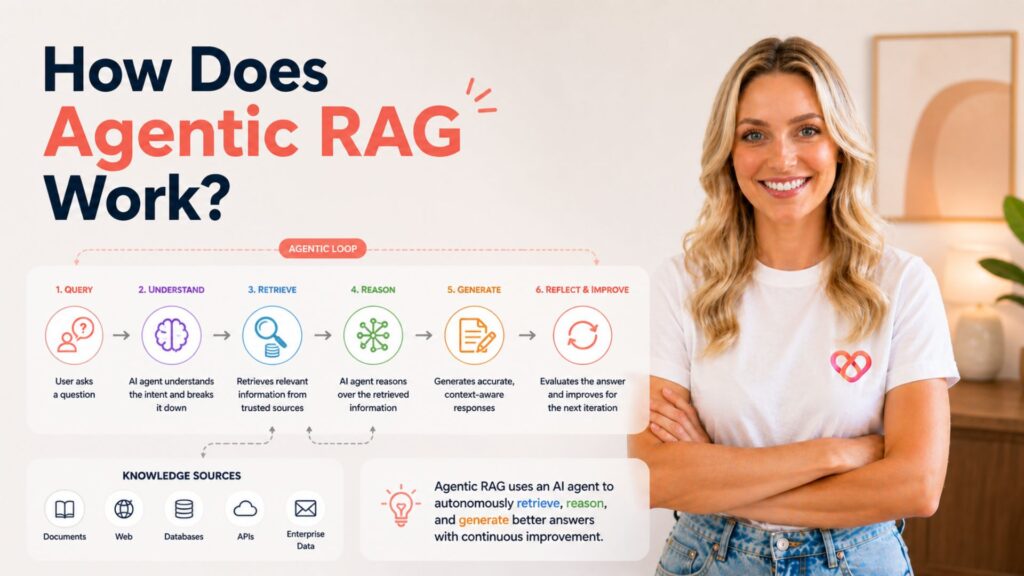
Retrieval-Augmented Generation, RAG, changed how AI systems access information. Instead of relying solely on what a model learned during training, RAG allows an AI to retrieve relevant documents at query time and use that retrieved content to produce more accurate, grounded responses.
But standard RAG has limits. It is a single-pass process: retrieve, then generate. The retrieval step is fixed, the sources are predetermined, and the system cannot adapt if the first retrieval does not return what it actually needs.
Agentic RAG changes this fundamentally. It brings the adaptive, goal-directed behavior of autonomous AI systems to the retrieval process itself, turning a linear pipeline into a dynamic, multi-step reasoning loop.
We explained exactly how agentic RAG works, why it is a significant improvement over standard RAG, and where it is already being applied in production.
Standard RAG: The Baseline
To understand what makes agentic RAG different, you need a clear picture of what standard RAG does.
In a standard RAG pipeline:
- A user submits a query
- The system encodes the query and searches a vector database for semantically similar document chunks
- The top-k retrieved chunks are injected into the model’s context
- The model generates a response using both its training knowledge and the retrieved content
This is a significant improvement over pure generation from training data alone, it grounds responses in specific, retrievable knowledge and allows the system to access information beyond its training cutoff. It works well for straightforward, well-scoped questions where a single retrieval pass is sufficient.
But it breaks down quickly when questions are complex, multi-part, ambiguous, or require synthesizing information from multiple sources that cannot all be retrieved in a single pass. Standard RAG does not know when its retrieval has failed. It does not reformulate queries or does not decide to look somewhere else. It retrieves once and generates regardless.
What Makes RAG Agentic
Agentic RAG introduces the core behavioral properties of agentic AI, planning, tool use, observation, and adaptation, into the retrieval process.
As covered in our breakdown of how agentic AI works, agentic systems operate in a continuous loop: they act, observe the result, reason about what happened, and decide what to do next. Agentic RAG applies this exact loop to retrieval.
Instead of retrieving once and generating, an agentic RAG system:
- Evaluates whether the retrieved content is actually sufficient before generating
- Reformulates the query if the initial retrieval is weak or irrelevant
- Retrieves from multiple sources in sequence or in parallel when a single source is not enough
- Decides dynamically which knowledge bases, APIs, or documents to query based on what the task requires
- Iterates until it has gathered enough high-quality information to generate a reliable response
The retrieval step is no longer a fixed, passive operation. It becomes an active, reasoning-driven process, governed by an agent that can think about what information it needs and go get it.
The Architecture of Agentic RAG
Most agentic RAG implementations share a common architectural pattern, built around an LLM acting as a reasoning and orchestration layer on top of one or more retrieval tools.
The Reasoning Agent
At the center of an agentic RAG system is an LLM that serves as the orchestrator. It receives the original query, reasons about what information is needed to answer it well, and decides how to retrieve that information. This is the component that transforms retrieval from a mechanical lookup into an intelligent, adaptive process.
Retrieval Tools
The agent has access to one or more retrieval tools, vector databases, keyword search indices, document stores, web search APIs, SQL databases, or any other information source relevant to the domain. In a standard RAG system, there is typically one retrieval source. In agentic RAG, the agent can choose between multiple sources and decide which to query based on the nature of the question.
Query Planning and Decomposition
For complex questions, the agent does not simply pass the original query to a retrieval tool. It decomposes the question into sub-queries, each targeting a specific piece of information needed to construct a complete answer. A question like “How does agentic RAG compare to standard RAG in terms of accuracy and latency?” might be decomposed into separate retrieval operations for accuracy benchmarks, latency comparisons, and architectural differences.
Retrieval Evaluation
After each retrieval step, the agent evaluates the quality and relevance of what was returned. This evaluation step is what fundamentally distinguishes agentic RAG from standard RAG. The agent asks: Is this information actually relevant to the question? Is it complete? Is it current? Does it contradict other retrieved content? Based on this evaluation, it decides whether to proceed to generation or to retrieve again with a refined approach.
Iterative Refinement
If retrieval quality is insufficient, the agent refines its approach. This might mean reformulating the query with different terminology, querying a different source, broadening or narrowing the search scope, or breaking the problem down differently. This iterative loop continues until the agent has assembled sufficient, high-quality information to generate a reliable response.
Generation
Only once the agent is satisfied with the retrieved content does it proceed to generation. The final response is grounded in a richer, more carefully curated set of retrieved information than a single-pass RAG system could produce.
Agentic RAG Patterns
Several distinct patterns have emerged in how agentic RAG systems are structured in practice.
Corrective RAG (CRAG) adds an explicit evaluation step after retrieval. The agent scores the relevance of retrieved documents and, if the score falls below a threshold, either refines the query or falls back to web search for more current information. This pattern is particularly effective for domains where the internal knowledge base may be incomplete or outdated.
Self-RAG incorporates reflection tokens, the model learns to generate special tokens that signal whether retrieval is needed, whether retrieved content is relevant, and whether the generated response is grounded. This allows the system to make retrieval decisions dynamically during generation, rather than as a separate pre-generation step.
Multi-hop RAG handles questions that require chaining together information from multiple retrieval steps. The agent retrieves an initial set of documents, extracts intermediate facts, uses those facts to formulate a follow-up query, retrieves again, and continues until it has assembled all the pieces needed for a complete answer. This is essential for questions that cannot be answered from any single document.
Adaptive RAG routes queries to different retrieval strategies based on query complexity. Simple factual questions go directly to a single retrieval step. Complex analytical questions trigger multi-hop retrieval. Ambiguous questions trigger a clarification step before retrieval begins. The routing decision is made by the agent based on an initial assessment of the query.
Agentic RAG vs. Standard RAG: A Direct Comparison
| Dimension | Standard RAG | Agentic RAG |
|---|---|---|
| Retrieval passes | Single | Multiple, iterative |
| Query formulation | Fixed | Dynamic, adaptive |
| Source selection | Predetermined | Decided at runtime |
| Retrieval evaluation | None | Active assessment |
| Failure handling | None | Reformulate and retry |
| Complexity handling | Limited | Multi-hop, decomposed |
| Latency | Lower | Higher |
| Accuracy on complex queries | Lower | Significantly higher |
The trade-off is clear: agentic RAG is more capable but more expensive in terms of latency and compute. For simple, well-scoped questions, standard RAG remains efficient. For complex, knowledge-intensive tasks, agentic RAG produces meaningfully better results.
Why Agentic RAG Matters Beyond Accuracy
The improvement in accuracy is the most obvious benefit of agentic RAG, but it is not the only one.
Reduced hallucination on complex topics. One of the core challenges of deploying AI in high-stakes domains is hallucination, the model generating confident, plausible-sounding content that is factually wrong. Agentic RAG significantly reduces this risk by grounding generation in actively verified, high-quality retrieved content rather than whatever happened to come back from a single retrieval pass.
Dynamic knowledge access. Standard RAG is limited to whatever is indexed in its vector database at query time. Agentic RAG can dynamically query live sources, web search, real-time APIs, freshly updated databases, allowing it to work with current information rather than a static snapshot.
Better handling of ambiguity. When a query is ambiguous, standard RAG retrieves based on its best guess at the meaning and generates regardless. An agentic RAG system can recognize ambiguity, reason about possible interpretations, and either ask a clarifying question or retrieve for multiple interpretations before generating.
Auditability. Because agentic RAG systems reason explicitly about each retrieval step, what they searched for, what they found, why they accepted or rejected it, their reasoning process is far more transparent and auditable than a single-pass retrieval system.
Where Agentic RAG Is Being Used
Agentic RAG is already deployed in production across several domains where the limitations of standard RAG are most acutely felt.
Legal and compliance research, where accurate, complete answers require synthesizing information from multiple documents, regulations, and case records that a single retrieval pass cannot adequately cover.
Medical and clinical decision support, where accuracy is critical, knowledge is rapidly evolving, and responses must be grounded in current, verified sources rather than static training data.
Enterprise knowledge management, where information is distributed across multiple systems, databases, and document repositories, and a single knowledge base cannot serve as the sole retrieval source.
Financial analysis, where answers to complex questions require combining market data, regulatory filings, news sources, and internal research in a single coherent response.
Agentic coding assistants, where understanding a complex codebase requires retrieving from documentation, source files, dependency references, and error logs in a coordinated, multi-step process.
The Relationship Between Agentic RAG and Agentic AI
It is worth being clear about how agentic RAG fits into the broader agentic AI picture.
Agentic RAG is not a standalone system, it is a pattern that exists within the larger context of agentic AI architecture. In a full agentic system, RAG is one of many tools an agent might use to gather the information it needs to complete a task. The agent decides when to retrieve, what to retrieve, and how to evaluate what comes back, treating retrieval as one capability among many rather than as the entire system.
This is why understanding what agentic means at a foundational level matters for understanding agentic RAG specifically. The “agentic” part is not a technical specification, it is a behavioral property. A RAG system is agentic when the retrieval process exhibits agency: when it plans, adapts, evaluates, and decides rather than simply executing a fixed procedure.
For anyone evaluating whether agentic AI is a genuine capability shift or just rebranded technology, agentic RAG is one of the clearest concrete examples of what the agentic layer actually adds. The underlying retrieval technology is the same. The underlying language model is the same. What changes is the intelligence governing how those components are used, and that change produces meaningfully better outcomes on the tasks that matter most.