
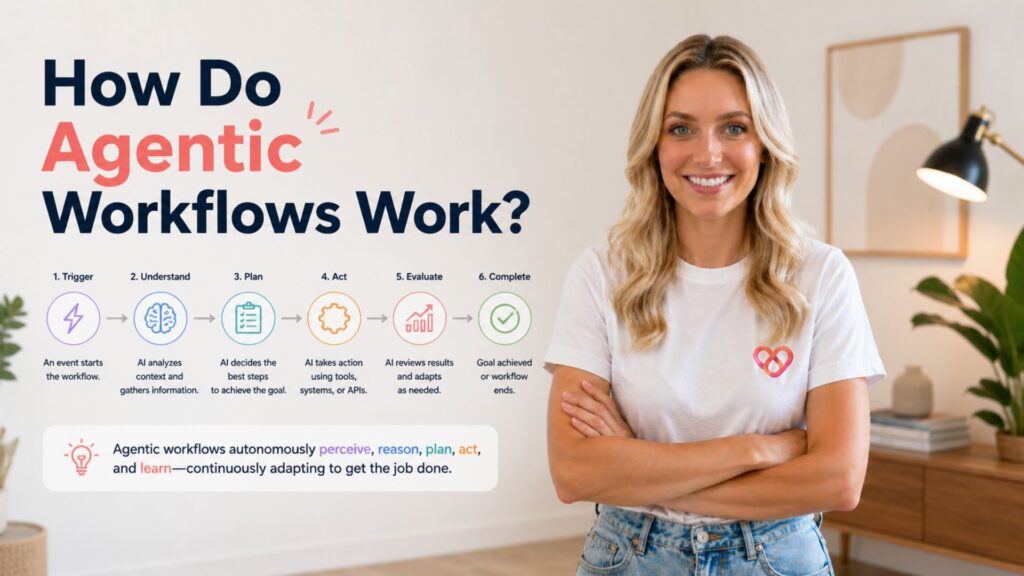
The term “agentic workflow” is appearing everywhere in enterprise software, AI tooling, and developer communities. But despite how frequently it is used, it is rarely explained in concrete, practical terms. What exactly is an agentic workflow? How is it different from a traditional workflow or a simple automation? And what does it look like in practice?
This guide answers all of those questions with clarity and depth.
What Is a Workflow in the First Place?
Before defining agentic workflows specifically, it helps to be clear about what a workflow is in general.
A workflow is a structured sequence of steps designed to accomplish a goal. In business and software contexts, workflows define how tasks move from initiation to completion, who does what, in what order, triggered by what conditions. A content approval process, an invoice processing pipeline, an employee onboarding sequence, these are all workflows.
Traditional workflows are typically:
- Predefined, every step is mapped out in advance
- Rule-based, conditions and branches are explicitly programmed
- Deterministic, given the same inputs, the same steps always execute in the same order
- Human-dependent, exceptions and edge cases require human intervention
Agentic workflows break from this model in fundamental ways.
What Makes a Workflow Agentic?
An agentic workflow is one where an AI agent, rather than a human or a fixed rule, is responsible for deciding what steps to take, in what order, using which tools, based on the goal and the current state of the task.
As explored in our guide on what is agentic AI, agentic systems are defined by their ability to plan, act, observe, and adapt autonomously. Applied to workflows, this means the agent does not follow a predetermined script. It reasons about the goal, determines the best path forward, executes steps, evaluates results, and adjusts as needed, all without requiring a human to specify every decision point in advance.
The defining characteristics of an agentic workflow are:
- Dynamic planning, the sequence of steps is determined at runtime, not hardcoded
- Tool use, the agent can invoke external tools, APIs, and services to gather information and take action
- Adaptive execution, if a step produces unexpected results, the agent can revise its approach
- Goal orientation, the agent is working toward an outcome, not simply executing instructions
- Minimal human intervention, the workflow runs autonomously, escalating to humans only when necessary
The Anatomy of an Agentic Workflow
Every agentic workflow, regardless of domain or complexity, shares the same fundamental structure. Understanding this structure is the key to understanding how agentic workflows actually function.
Step 1: Goal Definition
Everything starts with a goal. The agent receives a high-level objective, either from a human, another system, or a triggering event. The quality and specificity of the goal has a significant impact on the quality of the outcome. A well-specified goal gives the agent clear success criteria; a vague goal leaves too much room for interpretation and increases the risk of misalignment.
Step 2: Task Decomposition and Planning
Once the agent has a goal, it breaks that goal down into a sequence of sub-tasks. This planning step is where the reasoning capability of the underlying large language model is most critical.
The agent considers: What information do I need? What tools are available to me? The logical order of operations, dependencies exist between steps, What could go wrong, and how should I handle it?
This is not a one-time planning exercise, the agent revisits and revises its plan throughout the workflow as new information becomes available.
Step 3: Action Execution
With a plan in place, the agent begins executing steps. Each step typically involves calling a tool, a web search, a database query, a code execution, an API call, a file operation. The agent constructs the appropriate input for the tool, executes the call, and receives an output.
As explained in our detailed breakdown of how does agentic AI work, tools are the mechanism through which agentic systems interact with the world beyond their internal knowledge. Without tools, an agent can reason and plan but cannot act.
Step 4: Observation and Evaluation
After each action, the agent observes the result and evaluates it against expectations. Did the tool return the expected type of information? Is the output complete and accurate? Does this result change the plan for subsequent steps?
This observation step is what makes agentic workflows fundamentally different from traditional automation. A rule-based automation simply passes outputs from one step to the next without evaluating their quality or relevance. An agentic workflow actively interprets each result and uses it to inform the next decision.
Step 5: Adaptation and Iteration
In case of the result of a step is not what was expected, a search returns irrelevant results, a code execution produces an error, an API call fails, the agent does not stop. It reasons about what went wrong and attempts an alternative approach.
This adaptive capability is what allows agentic workflows to handle the messiness of real-world tasks. Edge cases, unexpected inputs, and partial failures are inevitable in complex workflows. Agentic systems can navigate these situations in ways that brittle, rule-based automations cannot.
Step 6: Completion and Output Delivery
Once all sub-tasks have been completed and the goal has been achieved, the agent delivers the final output, a document, a report, a set of actions taken, a decision made. In many agentic workflows, this final step also includes a self-review: the agent checks its own output against the original goal before declaring the task complete.
Types of Agentic Workflows
All agentic workflows are not structured the same way. Several distinct patterns have emerged as the most common architectures.
Sequential workflows
They are the simplest form, steps execute one after another, with each step’s output feeding into the next. Despite being the most straightforward, sequential agentic workflows are already far more capable than traditional automation because each step involves active reasoning and tool use rather than fixed rule execution.
Parallel workflows
This involves multiple tasks executing simultaneously. An agent might dispatch several tool calls at once, running three different web searches in parallel, for example, and then synthesize the results. This significantly reduces the time required to complete information-gathering tasks.
Branching workflows
These involve conditional logic where the path the workflow takes depends on intermediate results. If a search returns strong results, proceed to synthesis. If results are weak, try a different approach before proceeding. The agent determines which branch to take based on its evaluation of each step’s output.
Iterative workflows
Iterative workflows involve loops, the agent repeats a set of steps until a quality threshold is met or a goal is achieved. A code-writing agent, for example, might write code, test it, identify failures, fix them, and repeat until all tests pass.
Multi-agent workflows
Multi-agent workflows involve multiple specialized agents working in coordination. An orchestrator agent manages the overall workflow and delegates sub-tasks to specialist agents, a research agent, a writing agent, a review agent, each operating within its area of expertise. This is the most complex and powerful agentic workflow architecture, and also the one most relevant to enterprise-scale deployments.
Agentic Workflows vs. Traditional Automation
The contrast between agentic workflows and traditional automation, including Robotic Process Automation (RPA), is worth examining directly, because it clarifies what is genuinely new about the agentic approach.
Traditional RPA automates repetitive, rule-based tasks by mimicking human interactions with software interfaces. It is powerful for structured, predictable processes, data entry, form filling, report generation from fixed templates. But it is brittle. Change the interface it is automating, introduce an unexpected input, or encounter an edge case not covered by the rules, and traditional automation breaks.
Agentic workflows are fundamentally more robust because they reason about tasks rather than following scripts. They can handle variation, ambiguity, and unexpected situations because the decision-making layer, the LLM, can interpret context and adapt in ways that a rule-based system cannot.
This is not to say agentic workflows are always better. For highly structured, high-volume, low-variability tasks, traditional automation remains efficient and reliable. But for complex, knowledge-intensive tasks that involve judgment, synthesis, and adaptation, the kinds of tasks that previously required human cognitive work, agentic workflows represent a qualitative leap forward.
Real-World Examples of Agentic Workflows
Understanding the concept is easier with concrete examples.
Sales intelligence workflow: An agent receives a list of prospect companies, searches for recent news and financial information about each, checks LinkedIn for key contacts, cross-references with a CRM database, and produces a prioritized outreach brief, all without human input at each step.
Content production workflow: An agent receives a topic brief, researches current information, generates an outline, writes a draft, checks it against brand guidelines, formats it for publication, and flags it for human review, completing in minutes what previously took hours.
Software debugging workflow: An agent receives a bug report, locates the relevant code, reproduces the error in a sandbox environment, identifies the root cause, generates a fix, runs the test suite, and submits a pull request, with a human reviewing only the final output.
Customer support escalation workflow: An agent receives an incoming support ticket, retrieves the customer’s account history, diagnoses the issue by querying internal documentation, attempts a resolution, and escalates to a human agent only if the resolution fails, with a full context summary prepared for the human reviewer.
The Human-in-the-Loop Question
One of the most important design decisions in any agentic workflow is determining where and how humans remain in the loop.
Fully autonomous workflows, where the agent operates from start to finish without human intervention, are appropriate for low-stakes, well-defined tasks where errors are easily detected and corrected. For higher-stakes tasks, human checkpoints are essential: moments where the agent pauses, presents its work so far, and waits for human approval before proceeding.
This is not a limitation of agentic AI, it is good design. As discussed in our article on is agentic AI just hype, one of the key factors separating successful agentic deployments from failed ones is the thoughtfulness with which human oversight is built into the workflow.
The right level of human involvement depends on the stakes involved, the reliability of the agent in that specific domain, and the reversibility of the actions being taken. An agent that sends emails on your behalf requires more oversight than one that drafts them for your review.
Why Agentic Workflows Matter
The significance of agentic workflows goes beyond efficiency. They represent a shift in the fundamental nature of what AI can contribute to human work.
As covered in is agentic AI the same as generative AI, the distinction between generating content and taking action is profound. Generative AI made AI a powerful tool for producing outputs. Agentic workflows make AI a participant in processes, capable of owning tasks, navigating complexity, and delivering results rather than just generating material for humans to act on.
For organizations, this means AI is no longer limited to augmenting individual tasks. It can orchestrate entire processes. And for knowledge workers, it means the nature of human contribution is shifting, away from execution and toward goal-setting, judgment, and oversight of AI-driven workflows.
Understanding how agentic workflows work is therefore not just a technical question. It is a prerequisite for understanding how work itself is changing, and how to build, deploy, and manage AI systems that are genuinely capable of delivering on that promise.